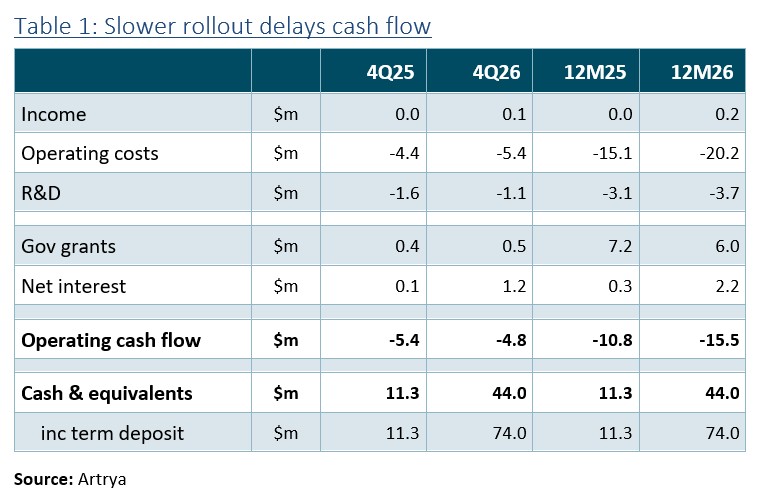
Artrya released its 4Q26 cash flow report today. Overall, it was a disappointing read (shares closed down -6.3%), with cash receipts below expectations, a slower-than-expected rollout of Salix to the foundation partners and no real news regarding the submission of Salix Coronary Flow for FDA clearance.
Cash receipts below expectations
Artrya reported just $60,000 in cash receipts for the quarter. Assuming the group charges its targeted US$750 per Salix Coronary Plaque scan, this implies its foundation partner, Tanner, completed fewer than 56 scans during the quarter. This is below our expectations and is disappointing, given that Tanner signed the commercial agreement 12 months ago and had rolled the platform out across its 5 hospitals by the end of April.
Conference call: 30th July, 10:00 am AEST/8:00 am AWST
The following is a summary of the key points from Artrya’s 4Q26 cash flow announcement. We hope to get more colour from the investor call being hosted tomorrow. Venn Brown’s forecasts and valuation are under review.
Commercial discussions – the positive part
Overall, while it was a fairly disappointing results announcement, management’s comments regarding commercialisation opportunities were positive.
Management reported that it continued to expand the commercial pipeline with “increasing engagement from leading health systems”.
Further, and more interestingly given the established relationships, the size and calibre of the participants, AYA reported that during the quarter it “continued to advance commercial discussions with a number of SAPPHIRE sites”
A major aim of the SAPPHIRE study has always been to turn the partners into commercial customers.
Our current forecasts do not expect this to occur until FY28 and we see any progress down this path as overwhelmingly positive.
Unfortunately, given the various early proclamations AYA has made over the years, which have then been delayed, we expect the market to take a “wait and see” stance.
Cash flow
Artrya delivered $60,000 in cash receipts for the quarter, bringing total cash receipts for the year to $176k. This is well below our expected $5 million in scan revenue.
Assuming AYA is charging its targeted $750 per SCP analysis, the $60,000 implies fewer than 56 SCP scans were performed (or at least paid for) during the quarter, and fewer than 164 during the whole year.
What’s not clear is whether the lack of scan volume is a result of:
1) clinicians disliking the product (very bad),
2) delay in payer pre-authorisation preventing the use of SCP (bad but not lethal if it can be fixed); or
3) something else entirely.
Steve West (Tanner Health) commented during his visit in May that clinicians were very happy with Salix, that they were seeing significant time savings from using it and that scan volumes were doubling month on month.
If this is the case, they’re doubling from an extraordinarily low base.
AYA’s buy case rests on West’s comments being true and that some other solvable issue is the reason for the low scan volumes.
Hopefully tomorrow’s call will shed some light on the situation and outlook.
Forecasts and valuation under review
Artrya delivered $176k in customer receipts for FY26, well below our targeted $5 million, due to a significant overestimation of the number of SCP scans conducted in the second half of the year.
At this stage, it’s unclear what caused the disappointing scan volumes, and we remain cautiously optimistic that it's teething problems associated with rollout and onboarding or issues specific to the partners rather than something fundamental or systemic with the product, workflow, or payments.